
Clear Creek Siding Meets Wildfire Urban Interface (WUI) Fire Resistant Requirements
Recently, we’ve had multiple people reach out from the Colorado area that are dealing with the WUI (Wildfire Urban Interface) and not being able to get permits for new builds without a fire resistant product. Fire-resistant siding , including Clear Creek’s concrete log siding, meet these requirements. We offer homeowners and builders a way to preserve the appearance of natural wood while addressing increasingly demanding construction standards.
There is a long tradition in America of putting up one’s dream home right on the edge of the wild. Log cabins set into the Colorado mountains or a cedar-sided retreat among the redwoods of Northern California such properties offer a measure of privacy and tranquility, a real link to the natural world.
But for the homeowner in the American West, that closeness to nature has become an expensive risk. Insurance companies are sending notices of steep premium hikes (or even a refusal to renew).
All of this comes down to the Wildland-Urban Interface, or WUI. The term refers to where development and undeveloped vegetation come together. It is now the defining factor in residential construction, dictating everything from the permits and insurance to the kind of siding and roof one can put on a house.
At Clear Creek Siding, we fill a vital role in offering a product that looks and feels like wood, but offers a Class 1/A fire safety rating.
Why Wildland-Urban Interface Requirements Were Created

No one insurance company or federal agency claims credit for the Wildland-Urban Interface. There was no top-down edict from Washington to tell Americans they could no longer put up wooden homes in the shadow of a forest.
Rather, the term is the product of decades of research by scientists, land-use planners, insurance agents and firefighters, looking for a practical solution.
In the past, wildfires were viewed as a hazard to the natural world – the forests and grasslands.
The picture has changed with the spread of suburbia into once-undeveloped territory. A house is now part of the very environment a fire will travel through. The numbers bear this out: Headwaters Economics put out a study in 2016 showing some 60 percent of all new single-family homes in the U.S. since 1990 have been built in the WUI.
The results are what one would expect. With more homes come more structures at risk, more potential points of ignition and a heavier toll on firefighting resources.
Federal bodies like the United States Forest Service have put in place standard ways of mapping these zones.
On the regulatory side, the International Code Council has the IWUIC, a model code for curbing wildfire damage. But the ICC is not a federal enforcer; its codes only carry the weight of law if a state or local government chooses to adopt them.
That is why you will see a patchwork of WUI construction rules from one end of the country to the other. Some places go with the IWUIC while others forge their own path.
California, Colorado, Oregon and Washington have all taken different tacks. In California, Chapter 7A lays down the law for exterior work in high-hazard zones, covering everything from the roof and siding to the vents and decks. The idea is to make sure a building does not catch from windblown embers or radiant heat. For those in the business of building or owning a home, the implications are anything but trivial.
In jurisdictions where WUI exterior-wall requirements apply, a proposed home may not receive building approval unless its siding and wall assembly satisfy the applicable fire-resistance provisions.
That has created growing demand for alternatives to conventional combustible wood siding.
Why Traditional Wood Siding Is Becoming a Problem
The ties between mountain architecture and wildfire protection have an uncomfortable irony.
The American notion of mountain living is hard to separate from traditional log homes, cedar siding and exposed timber. But those very materials can leave a building at risk in a wildfire.
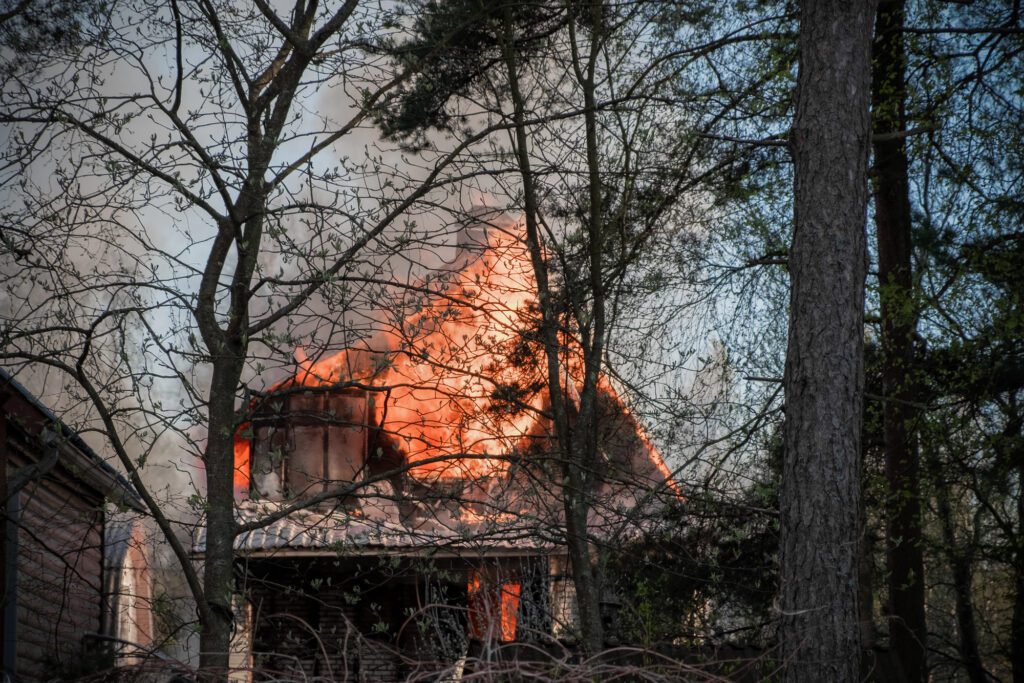
Wood is, well, combustible. In the event of a fire, embers on the wind travels miles ahead of the main blaze and make for vulnerable spots around a home.
They can find their way into gaps in the exterior work, build up under decks or rest against the siding. From there the fire can get a hold of the rest of the structure.
Clear Creek Siding Offers Fire-Resistant Concrete Log Siding
Clear Creek’s concrete log and timber siding is made to look (and feel) like traditional wood construction. Each log uses an imprint of a real log – creating an unmatched, real-wood look.
It delivers an architectural feel of a log cabin with fire-performance qualities.
Clear Creek’s products has been given a Class 1/A fire rating, which attests to how it performs under the prescribed testing method.
Don’t assume, however, that a Class 1/A surface-burning performance and WUI building-code compliance are one and the same. There are jurisdictions where exterior walls have to meet other criteria for approval, testing or construction.
We can supply our fire-resistant documentation for you to submit to your local zoning commission for approval.
We are finding that our product is the winning choice time and time again for both a rustic look and the stringent building codes in fire-prone areas.
How WUI Building Codes Are Enforced
State and local building and fire authorities see to it that wildfire-resistant construction standards are followed.
This enforcement process usually starts at the point of a building-permit application.
Sometimes insurance rules set the standards for what can – and cannot – be built.
California has its own way of doing things with Chapter 7A, which sets out the rules for areas of wildfire hazard.
Jurisdictions like Spokane, Washington, which have put in place local WUI regulations under the International Wildland-Urban Interface Code. Enforcement is left to the city’s building and fire officials and the ordinance carries penalties for any violations.
The Insurance Crisis Is Making Fire-Resistant Exteriors More Important
Building regulations are only one part of the problem.
Homeowners insurance has become another.
Between 2018 and 2023, Colorado homeowners insurance premiums increased approximately 58 percent.
The state had become the sixth most expensive in the country for homeowners insurance, with an average annual premium of $4,072 for $300,000 in coverage.
More than 321,000 Colorado homes faced moderate or greater wildfire risk, representing approximately $141 billion in potential reconstruction costs.
Following the devastating 2021 Marshall Fire, researchers found that 74 percent of affected homeowners were underinsured.
In high-risk areas, companies may increase premiums, require mitigation improvements, limit coverage, or decline to renew existing policies.
Some homeowners are discovering that the materials used to construct their homes are part of the insurance company’s assessment.
But unlike building codes, insurance underwriting standards are often proprietary.
A homeowner may satisfy local construction requirements and still be denied coverage.
What Homeowners Are Saying About WUI Requirements
The uncertainty is increasingly visible in online discussions.
In a Reddit conversation titled Looking at homes in WUI zones. What’s the reality for owners?, a prospective buyer described searching for houses in the San Jose area.
Several attractive properties were located within city limits, a few blocks away from the hills. However, they were still classified as being within WUI areas.
One commenter explained that insurance was often the greatest concern. Some properties could still obtain conventional coverage, while others required California FAIR Plan insurance combined with supplemental policies.
Another commenter explained that government wildfire maps and private insurance risk models are different systems.
A house may look perfectly ordinary.
Its neighborhood may appear thoroughly suburban.
Yet its location and construction characteristics can affect whether an insurance company is willing to issue a policy.
Why Concrete Log Siding Makes Sense for WUI Construction
Clear Creek Siding is the perfect answer where fire resistant siding is required by building ordinances.
It has the look of a conventional log home yet, being made of concrete, it offers fire-performance qualities you do not get from wood. Plus you get the upside of hail resistance and insect resistance.
If you are building in a WUI zone, reach out for our documentation that you can submit to your planning committee for approval. If you have an existing house that has lost insurance, consider residing your existing house with a concrete siding for long-term fire resistance.
